
Many people dream of owning a hot tub, and with today’s advancements in technology and income, the ability to own a luxury home spa is open to more people than ever before. Overall, the global hot tub market is forecast to increase between now and 2030, growing from approximately $6.06 billion USD in 2026 to $8.47 billion USD in 2030 [1]. But who exactly is buying hot tubs these days, why are they buying, and what are they spending?
The guide below focuses on helping you understand buyer trends for hot tubs in 2026, giving you valuable insights into what the consumer base on modern hot tubs looks like, what is motivating purchases, and how much you can expect to spend for a high-end hot tub from several quality brands.
Hot Tub Consumer Demographics in 2026
As of 2026, market estimates indicate that U.S. consumers own approximately 5.8-7.3 million hot tubs [2]. In general, trends showcase that the leading demographic in the hot tub market for 2026 is health-conscious, tech-savvy homeowners who are looking for hot tubs and home spas that support various types of hydrotherapy and have advanced technological features [3].
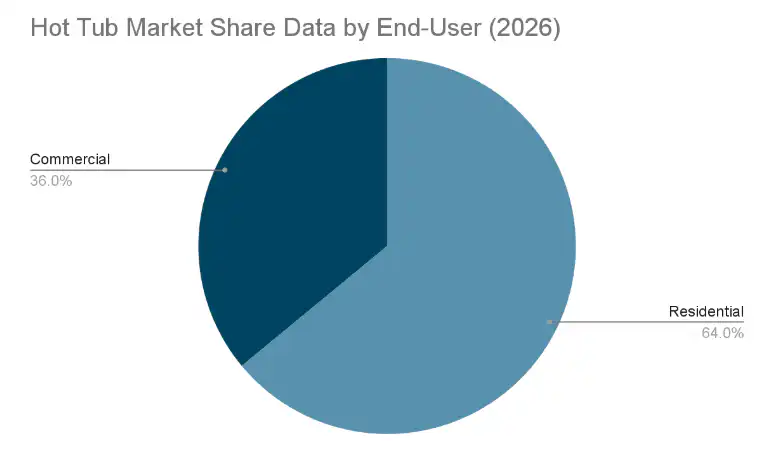
In particular, affluent homeowners in suburban North America make up a high percentage of hot tub end-users, with the North American region holding 41.84% of the global hot tub market share [3]. However, a combination of rising incomes and price moderation have allowed certain hot tubs to become more affordable to a wide variety of consumer brackets. Overall, 64% of hot tubs in the U.S. are owned by residential end-users, while 36% are owned by commercial end-users such as vacation rental businesses and spa establishments [4].
Residential End-Users
Residential Hot Tub End-User Interest | Hot Tub Uses |
Relaxation |
|
Entertainment |
|
Hydrotherapy |
|
Residential end-users make up the majority share of hot tub purchasers in 2026. Many of these buyers are affluent homeowners who use hot tubs for relaxation and social interaction. However, a growing share of the hot tub market is occupied by the health and wellness niche.
Modern hot tubs increasingly support advanced forms of hydrotherapy and massage, which can assist in various medical exercises and rehabilitation plans [5]. Many residential end-users purchase hot tubs with hydrotherapy capabilities to assist in medical recovery in addition to common motives such as relaxation and entertainment.
Commercial End-Users
Commercial Hot Tub End-User Interest | Hot Tub Uses |
Hospitality |
|
Health and Wellness |
|
Residential Communities |
|
Specialized Facilities |
|
Commercial end-users make up the other portion of hot tub ownership market share. These end users own hot tubs for the purposes of offering their benefits as part of a commercial enterprise. For example, homeowners may make commercial use of a hot tub located at a secondary property that they use as a vacation rental. Hot tubs may also be used commercially by hotels and resorts, day spas, athletic facilities, and as resources for the residents or members of an apartment complex, university, or retirement community.
Household Penetration Rates
Estimates indicate that anywhere between 2.0% [2] and 4.6% [6] of U.S. households own a hot tub. In comparison to the 0.8% global household penetration rate, this figure is fairly high, indicating the high degree of penetration for hot tubs in American markets and the large number of end-users who are localized in North America [3].
Why Are End-Users Buying Hot Tubs?

Lifestyle
While the health and wellness niche of the hot tub market is growing, the vast majority of end-users still purchase hot tubs for lifestyle reasons, including relaxation, socialization, and entertainment [7]. Hot tub buyers often gravitate towards spa purchases for a variety of social and lifestyle reasons, including outdoor parties and entertainment, relaxation during winter months, and general stress reduction.
Health
A growing facet of hot tub consumer motivation is health and wellness. In addition to various mental health benefits, hot tubs can improve physical health in many ways, reducing inflammation, relaxing muscles, improving sleep, and even benefiting your cardiovascular and respiratory health. Hot tubs and swim spas also appeal to consumers who enjoy various water exercises such as water aerobics, resistance training, and swimming.
Property Value
Aside from health and lifestyle, some homeowners choose to purchase a hot tub primarily to increase the property value of their home. Many hot tubs can provide a significant boost to property value if you are selling your home, motivating some users to buy a hot tub for perceived return on investment. Additional property value can also be gained if a hot tub is energy efficient, another factor behind the increase in market share for energy efficient tubs.
Hot Tub Consumer Spending Data in 2026
Hot Tub Price Ranges By Category
Hot Tub Tier | Price Range [2] | Features |
Inflatable | $400–$1,800 |
|
Standard | $2,500–$5,000 |
|
Premium | $5,000–$11,000 |
|
Luxury | $11,000–$35,000+ |
|
Hot tub consumers spend anywhere from $400 to over $35,000 on a hot tub in 2026, depending on their needs, their budget, and the features they desire. Low-end, inflatable hot tubs cater to consumers who are looking for a quick, portable, and temporary hot tub experience. Standard to luxury models offer increasingly-advanced features, including high-power jets, insulation, lighting, and hydrotherapy [2]. These hot tubs cost around $5,000 for standard models, around $10,000 for premium models, and often over $20,000 for luxury models, though individual dealer prices may vary [2].
Annual Hot Tub Operating Costs
Aside from the base purchase price and delivery or installation fees, hot tub owners in 2026 also face various annual operating costs that impact the yearly expenses of their hot tubs. In general, owners can expect to pay between $10 and $50 a month for electricity use for their hot tubs, depending on voltage, insulation, and energy efficiency [2]. An additional $500 to $1,000 a year accounts for routine maintenance of the hot tubs systems, chemicals, and filters [2]. Finally, owners can expect to pay between $200 and $600 as-needed on repairs if hot tub systems malfunction [2].
Hot Tub Price Breakdown: Popular Brand Models and Costs
Brand | Model | Price |
Catalina Luxury Spas | $11,299-$18,499 | |
Dr. Wellness | $7,999-$12,899 | |
Tuff Spas | $6,499-$9,499 | |
Plug & Power | $5,699-$8,899 | |
Hudson Bay | $3,699-$6,699 |
Choosing the right hot tub dealer is an important part of getting a fair value for your money. Expensive dealers can offer a large number of features, but often do so at a high price point, with costs that range between $15,000 and $20,000 or more even for more standard models. By contrast, dealers like Hottub.com offer a wide array of features at lower price points, with similar guarantees of quality and performance.
Key Takeaways
- Recreational and residential users are the primary buyers of hot tubs in 2026.
- End-Users buy hot tubs largely for lifestyle needs, but also for health and wellness and property value investment.
- Owners may spend anywhere from $400 to over $35,000 on a hot tub depending on dealer, brand, features, and construction.
- Additional costs, such as electricity, maintenance, and repairs affect hot tub prices.
Conclusion
Buying a hot tub comes with a lot of considerations. If you’re concerned about price and quality, Hotttub.com offers a variety of options. Hotttub.com’s Aqua Living brand is the largest hot tub retailer in the United States, with nearly 100 store locations, an experienced sales team, and over 8,000 five-star reviews. Hot tub living no longer has to be something for the rich and famous! With the right choice of dealer and model, anyone can benefit from the health benefits and stress-reduction features of a great spa!
Sources
- Hot Tub Market Size, Share, Trends | Growth Forecast [2034]. (n.d.). https://www.fortunebusinessinsights.com/hot-tub-market-104629
- Hot tub statistics 2026. (n.d.). Consumer Affairs. https://www.consumeraffairs.com/homeowners/hot-tub-statistics.html
- Markets, R. A. (2026, January 23). Hot Tub Market Analysis Report 2026 – Global industry Size, share, Trends, Opportunity, and Forecast, 2021-2031. Yahoo Finance. https://finance.yahoo.com/news/hot-tub-market-analysis-report-134900246.html?guccounter=1&guce_referrer=aHR0cHM6Ly93d3cuZ29vZ2xlLmNvbS8&guce_referrer_sig=AQAAAGXnfqigsIV9B239LaxS-3GaoD5aFX-gZFsW5XaxTDJhYqDRG_IvLI_qx-CL0o1C7uf9z-HdE4klCh_Hv7Y6X4cJbyMvx8C6Qw_F_dp7QeyVTLTCGraEZrQO0AOWOHI6f-tKJ1phA5PNuoRQSrj4S1Sfl7LLn4N-aVsSEx-vxst3
- Intelligence, M. (2025, November 3). Hot Tub Market Analysis | Industry Growth, Size & Forecast Report. Mordor Intelligence. https://www.mordorintelligence.com/industry-reports/hot-tub-market
- Professional, C. C. M. (2025, November 5). Hydrotherapy. Cleveland Clinic. https://my.clevelandclinic.org/health/treatments/23137-hydrotherapy
- Pangarkar, T. (2024, October 28). Hot tub market to reach USD 6.4 billion by 2033. Market.us News. https://www.news.market.us/hot-tub-market-news/
- Why Hot Tubs Are Becoming More Popular. (2023, November 21). Above and Beyond KC. https://www.aboveandbeyondkc.com/why-hot-tubs-are-becoming-more-popular