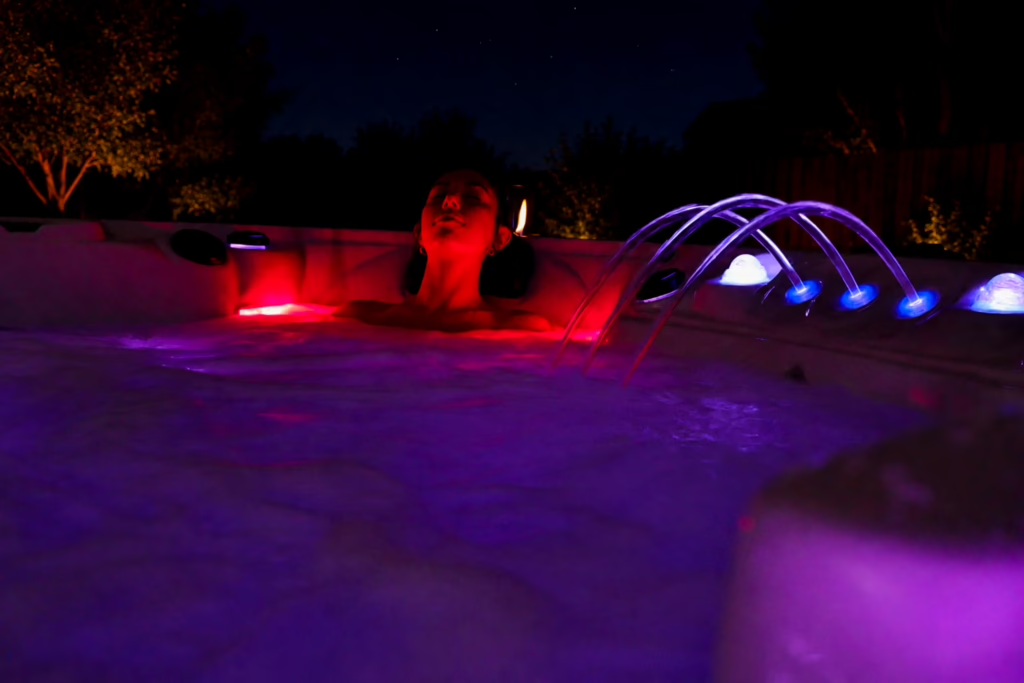
Most spa lights are decoration. This page sets out exactly what ours is, what the published research on red light does and does not support, and where the two meet—which is a narrower place than the category usually admits.
A specification, not a promise
Wavelength and placement are measured facts. Dose and clinical equivalence are not claimed.
Confirmed by direct measurement on our own units and photographed for the record.
Verified
Above the waterline
Recessed into the shell, aimed at the part of you that is out of the water.
Verified
Holds on red
The color channel can be set to red and left there—it does not have to cycle.
The Honest Opener
Color cycling is atmosphere. Only red has research behind it.
Competitors sell seven-color chromotherapy as though the colors were interchangeable therapies. They are not. Blue and green in this spa are there because colored light at night is pleasant, and for no other reason. Red is the one wavelength with a body of controlled human skin research behind it, and it is the only one this page discusses in research terms.
The Geometry
Why above the waterline is the whole engineering story
Light does not travel usefully through moving water. An underwater emitter points at submerged tissue, through a diffusing medium, usually from a long way off. Ours points at the part of you that is dry and uncovered—face, neck, shoulders, and décolletage—from above the surface.
That is a design fact about where the emitter sits. It is not, on its own, a claim about what happens to your skin.
Emitter position relative to the waterline
What This Does Not Mean
Pointing the right color at the right skin is not the same as delivering a dose
Everything in the research section that follows was produced by a specific amount of light, delivered over a specific number of dedicated sessions, at a specific distance. Dose is irradiance multiplied by time, and irradiance falls sharply with distance and angle. We know our wavelength. We have not measured what reaches a seated bather’s face—so we do not claim a dose, equivalence, or session length.
Mota 2023, 660 nm periocular
3.8 J/cm²
10 sessions over 4 weeks
Wunsch 2014, 611–650 nm
~9 J/cm²
30 sessions
General guidance, superficial tissue
3–10 J/cm²
2–5×/week for 4–7 weeks
Each published example is a course: repeated, deliberate, close-range sessions over weeks. Even a favorable measurement would not turn a hot tub into a dermatology device. A spa is a place to enjoy the light, not a substitute for one.
What the Research Found
Four studies on red light and skin
These are findings from dedicated clinical photobiomodulation protocols. They are reported because they are the honest basis for saying 660 nm is a researched wavelength rather than a marketing number. They are not results attributed to this product.
Randomized controlled trial
137 women aged 40–65 · split-face
Red light at 660 nm reduced periocular wrinkle volume by about 31%
Mota et al., Photobiomodulation, Photomedicine, and Laser Surgery, 2023. Red light at 660 nm and amber light at 590 nm were each delivered at 3.8 J/cm² per session for 10 sessions over 4 weeks. Wrinkle volume around the eye fell 31.6% with red and 29.9% with amber, measured by 3D imaging rather than opinion.
What it does not show— It does not show that a spa light achieves 3.8 J/cm² at the face. This is a useful benchmark precisely because it states the dose—and that is the number we cannot yet match ourselves against.
More procollagen and less collagen breakdown at 660 nm
Barolet et al., Journal of Investigative Dermatology, 2009. Type-1 procollagen was 31% higher and MMP-1 was 18% lower in treated tissue, with more than 90% of subjects showing reduced wrinkle depth and surface roughness after 12 treatments.
What it does not show— The clinical arm was split-face and single-blinded, not a full randomized trial, and bench results in engineered skin are not outcomes in people. It is the clearest mechanistic paper at our nominal wavelength.
Improved skin roughness and increased intradermal collagen density
Wunsch and Matuschka, Photomedicine and Laser Surgery, 2014. Polychromatic light was normalized to roughly 9 J/cm², twice weekly for 30 sessions. Blinded photography, profilometry, and ultrasound were used to assess the results.
What it does not show— This was a course of 30 dedicated exposures using broad polychromatic sources rather than a single-wavelength LED. The trial also involved commercial participation in the light source.
Photobiomodulation is safe for adults, and red light does not induce DNA damage
Maghfour, Mineroff, Ozog, Jagdeo et al., Journal of the American Academy of Dermatology, 2025. A systematic literature review, two Delphi rounds, two consensus meetings, and iterative review produced unanimous agreement.
What it does not show— This is a safety conclusion, not a product-efficacy conclusion. The panel’s effectiveness endorsements concern medical indications, which are outside anything a spa can claim.
The only color in the system with a body of controlled human skin research behind it, and the only one we discuss in research terms. It can be held steady rather than cycled.
~415 nm
Blue
Atmosphere
Blue light has clinical uses in dermatology, but those concern medical conditions we cannot and do not claim to treat. In the evening it also works against the sleep mechanism. Ambiance, and not at bedtime.
~525 nm
Green
Atmosphere
The credible green-light research concerns a different intervention—hours of controlled exposure acting through the retina in a darkened room. That is not a spa session. Ambiance only.
Blue light in the evening also works directly against the mechanism described on our sleep page. Read the sleep page →
In a Showroom
Four questions to ask about any spa light
01
What wavelength is it, in nanometers?
If a showroom cannot give you a number, there is no specification to compare. Ours is 660 nm, measured on our own units.
02
Can it hold on one color?
A light that only cycles is a light show. Ask whether red can be held steady as a mode.
03
Where does the emitter sit relative to the waterline?
Above or below changes what the light can reach. Look at the shell and see for yourself.
04
Which models include it?
Not every shell ships with the 660 nm emitter. Confirm that the model in front of you is the one with it.
Questions
What people ask about the light
What wavelength is the light?
660 nanometers, confirmed by direct measurement on our own units and photographed for the record. That sits inside the 620–670 nm band used in published skin trials, including trials that used 660 nm specifically.
Is red light therapy safe?
A 21-expert international consensus published in 2025 concluded that photobiomodulation is a safe modality for adults and that red-light photobiomodulation does not induce DNA damage. Do not stare directly into the emitter.
Will sitting in the spa give me the results in the studies?
We cannot say that, and we will not. The published protocols are courses of 10 to 30 dedicated, close-range sessions at a stated dose. We have not measured what our emitter delivers at a seated bather’s face, so we make no equivalence claim.
What do the other colors do?
They set the mood. Blue and green are atmosphere. Only the red channel has a body of controlled human skin research behind it.
Is this an FDA-cleared device?
No. This is a wellness product. It is not a medical device, it is not FDA cleared or approved, and it is not intended to diagnose, treat, cure, or prevent any disease.
Showrooms
See where the emitter actually sits
Ask which models carry the 660 nm emitter, and look at the shell to see how far above the waterline it is mounted.
Do not stare directly into the emitter. Close your eyes or look away if the light is uncomfortable.
Do not exceed 104°F (40°C).
Ask a healthcare provider about hot-tub use during pregnancy.
People with cardiovascular conditions, high or low blood pressure, or reduced sensation should seek individualized guidance and keep first sessions short.
If you are photosensitive, or take medication that causes photosensitivity, speak to a healthcare provider before using the light.